Type 1 vs. Type 2 Decisions

FounderCulture is improving the odds for Founders • Become a Patron to support us.
Jeff Bezos of Amazon has a fantastic framework for decision making: Differentiating between "Type 1" and "Type 2" decisions. This can really help you define a "waterline" of what is & isn't safe to try in your company, as per Asking "Is This Safe to Try?" for Decision Making
Asking "Is This Safe to Try?" for …Here's how it works:
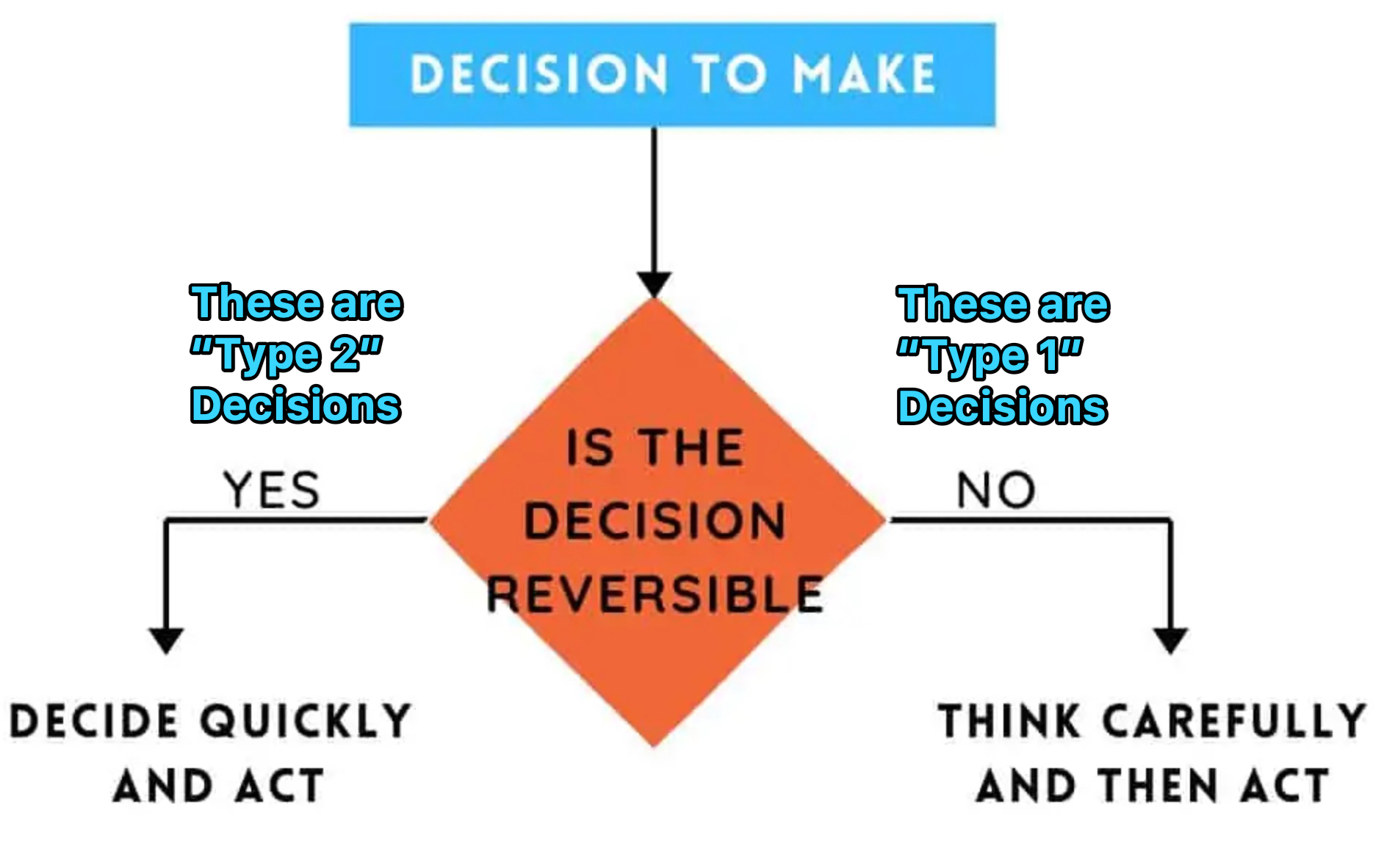
- Type 1 decisions: These are irreversible decisions that cannot be changed once executed. Therefore, they require careful thought.
- Type 2 decisions: These are reversible decisions. Even after executing them, you can change them if you like. Therefore, you must act on such decisions quickly.
This blog post has a great graphic that illustrates the decision making process:
Here's what People Often Get Wrong:
💡Understanding the difference in Type 1 vs. Type 2 is just the start. The important part is to ensure you don't fall into the trap most people do: Treating Type 2 decisions as if they were Type 1.
From Jeff Bezos’ Letter to 1997 Shareholders on irreversible (Type 1) vs. reversible (Type 2) decision making:
Some decisions are consequential and irreversible or nearly irreversible – one-way doors – and these decisions must be made methodically, carefully, slowly, with great deliberation and consultation. If you walk through and don’t like what you see on the other side, you can’t get back to where you were before. We can call these Type 1 decisions. But most decisions aren’t like that – they are changeable, reversible – they’re two-way doors. If you’ve made a suboptimal Type 2 decision, you don’t have to live with the consequences for that long. You can reopen the door and go back through. Type 2 decisions can and should be made quickly by high judgment individuals or small groups.As organizations get larger, there seems to be a tendency to use the heavy-weight Type 1 decision-making process on most decisions, including many Type 2 decisions. The end result of this is slowness, unthoughtful risk aversion, failure to experiment sufficiently, and consequently diminished invention.
Want to dig in further? This is a great post from Business Insider.
About FounderCulture: Only 1 of every 200 seed-funded startups make it to a $1Bn valuation. FounderCulture exists to improve those odds for Founders worldwide by removing the friction of founding and scaling venture-backed companies. We are building a trusted community to share knowledge with authenticity and vulnerability among Founders. FounderCulture is created by Founders, for Founders. Learn more about FounderCulture:
- Welcome to FounderCulture
- Why Founders Need FounderCulture
- Our Vision, Mission, Values & OKRs
Become a Patron if you'd like to see us create more content like this for Founders:
- Support FounderCulture: Become a Patron, Buy an NFT or send BTC/ETH .
- Thank you, FounderCulture Sponsors