Scaling Your GTM: The Demand / Land / Succeed / Expand Flywheel

FounderCulture is improving the odds for Founders • Become a Patron to support us.
💡 Watch all FounderCulture Casita Whiteboard S…on YouTube, here
Mistakes Seed & Series A Founders make when ramping up GTM:
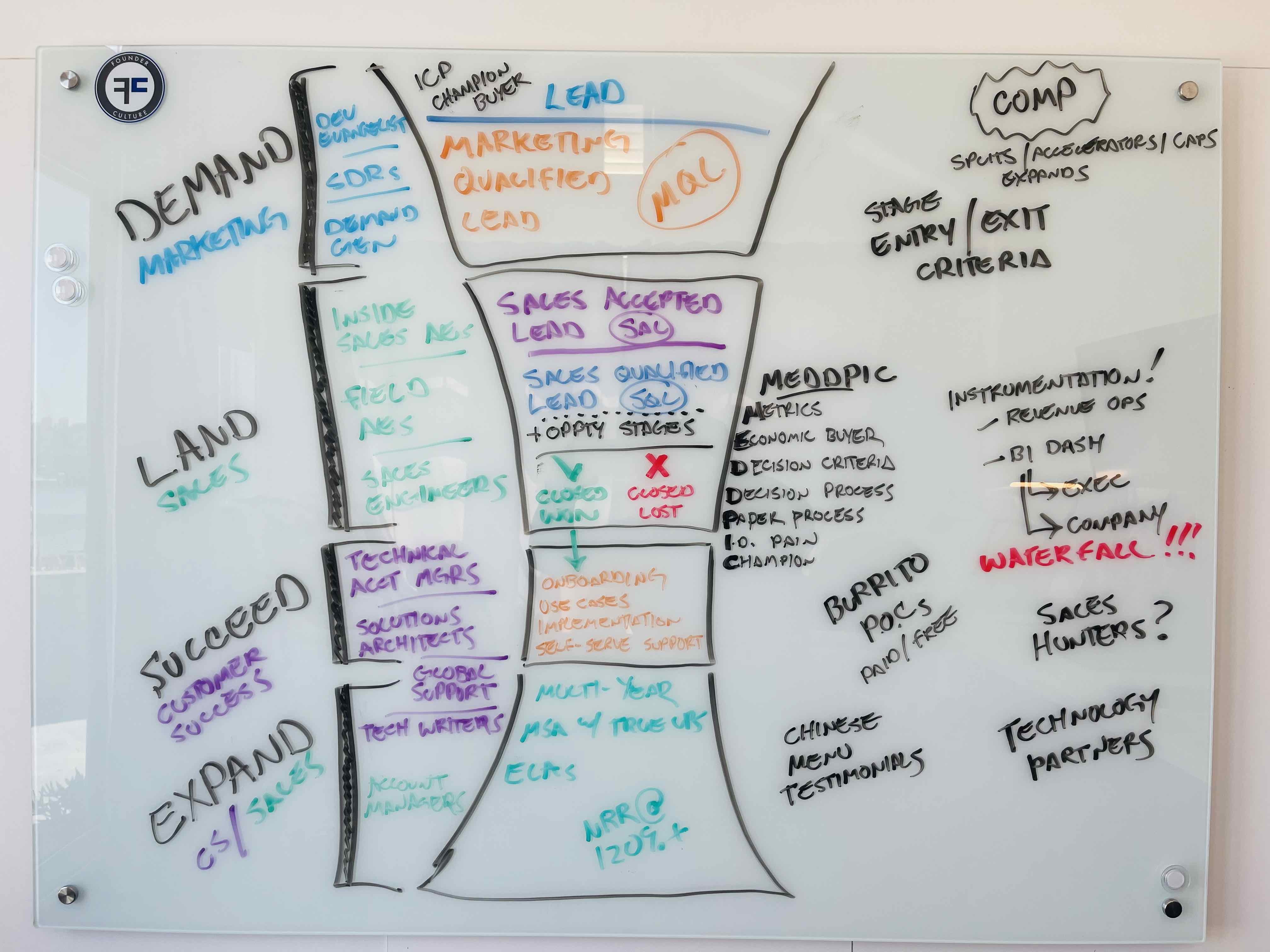
Demand / Land / Succeed / Expand GTM funnel, focused on moving from "Founder selling" to "building out your initial sales team," and with an emphasis on the landmines Founders consistently step on in the process.💡We recommend you consume From Stage Zero to One PMF: Foundational GTM Motions as a pre-cursor to watching this video
Here's a screenshot of the whiteboard that DROdio walks through in the video above:
💵 Buy the NFT of the image below to support FounderCulture. Make an offer or learn more: Support FounderCulture: Become a Patron, Buy an NFT or send BTC/ETH
💡 Below is the Storytell.ai machine-generated Storytell summary of this AMA. It may not be 100% accurate. Use it as a general guide.
The Demand Land Succeed and Expand Model: A Guide for Startups
In order to be successful in today's startup world, it is essential to have a clear understanding of your go-to-market motion, and to build a robust demand generation engine. This will ensure that you are able to generate a steady stream of qualified leads, and convert them into paying customers.
The first step is to define your ideal customer profile (ICP), champion, and buyer. Once you have a clear understanding of who your target customer is, you can begin to generate leads. There are a variety of ways to generate leads, including content marketing, search engine optimization (SEO), social media marketing, and paid advertising.
Once you have generated a list of leads, it is important to qualify them. This will help you to prioritize the most promising leads, and to allocate your resources more efficiently. There are a variety of criteria that you can use to qualify leads, including company size, budget, technology stack, and geographic location.
Once you have a list of qualified leads, it is time to start the sales process. The first step is to land the lead, which involves getting in touch with the lead and conducting an initial assessment. This assessment will help you to determine whether the lead is a good fit for your product or service.
If the lead is a good fit, the next step is to nurture the lead. This involves building a relationship with the lead, and providing them with valuable information that will help them to make a purchase decision.
Once the lead is ready to buy, the final step is to close the deal. This involves negotiating terms and conditions, and getting the lead to sign on the dotted line.
After the close, it is important to follow up with the customer to ensure they are satisfied and to continue developing the relationship. This can involve providing additional support, upselling additional products or services, or cross-selling complementary products or services.
Building a robust demand generation engine is essential for startup success. By following the steps outlined above, you can ensure that you are generating a steady stream of qualified leads, and converting them into paying customers.
Go Deeper with Story Tiles™
[0-5] min
The ethos of founder culture is to help scaling founders so early to mid-stage scaling founders not step on the same landmines as we stepped on as the scale-up founders. We have a community where we just try to share our learnings in ways that help you build more successful companies and it's like standing on the shoulders of giants each time.
The thing that we're specifically going to talk about today is the demand land succeed and expand model. In this model, the first thing that founders need to do is sell early and get their first set of passionate, successful customers. Then, they need to start building their monetization engine and team. Once they have a solid foundation, they can start expanding their customer base.
Each stage of this process has its own challenges and pitfalls that founders need to be aware of. For example, when selling early, founders often make the mistake of selling too soon. They need to make sure they have a good understanding of their product and market fit before they start selling. Additionally, when building their team, it's important that founders understand the difference between marketing, sales, and customer success. They also need to make sure they have the right tools in place to track their progress and activity. Finally, when expanding their customer base, they need to be careful not to over-sell or under-deliver on their promises.
By following the demand land succeed and expand model, founders can avoid many of the common mistakes made when scaling a business. By taking the time to understand each stage of the process and being aware of the challenges and pitfalls associated with each stage, founders can set their business up for success.
[5-10] min
In order to be successful in today's startup world, founders need to be very disciplined about their customer engagement and lead generation efforts. One of the best ways to ensure this is to build a waterfall from the very beginning of the go-to-market motion. This waterfall should include every stage of the customer journey, from awareness to purchase, and should be tracked over time to identify any bottlenecks or issues.
Lead generation is critical for any startup, and there are a number of different ways to go about it. Inbound marketing can be very effective, but outbound efforts (such as attending meetups, doing webinars, etc.) are also important. It's also crucial to be very intentional and thoughtful about who your ideal customer is, as this will help you focus your efforts.
Once you start generating leads, it's important to have at least 15 conversations with potential customers per week. This will help you not only learn more about your customer, but also identify any potential champions who can help you get your foot in the door at their company. It's also important to differentiate between good news (internal developments) and wins (external developments), as this will help you focus on the things that actually matter.
If you can be disciplined about your customer engagement and lead generation efforts, you'll be well on your way to success.
[10-16] min
In order to ensure that your startup is successful, it is essential to have a clear understanding of your go-to-market motion, and to build a robust demand generation engine. This will ensure that you are able to generate a steady stream of qualified leads, and convert them into paying customers.
The first step is to define your ideal customer profile (ICP), champion, and buyer. Once you have a clear understanding of who your target customer is, you can begin to generate leads. There are a variety of ways to generate leads, including content marketing, search engine optimization (SEO), social media marketing, and paid advertising.
Once you have generated a list of leads, it is important to qualify them. This will help you to prioritize the most promising leads, and to allocate your resources more efficiently. There are a variety of criteria that you can use to qualify leads, including company size, budget, technology stack, and geographic location.
Once you have a list of qualified leads, it is time to start the sales process. The first step is to land the lead, which involves getting in touch with the lead and conducting an initial assessment. This assessment will help you to determine whether the lead is a good fit for your product or service.
If the lead is a good fit, the next step is to nurture the lead. This involves building a relationship with the lead, and providing them with valuable information that will help them to make a purchase decision.
Once the lead is ready to buy, the final step is to close the deal. This involves negotiating terms and conditions, and getting the lead to sign on the dotted line.
Building a robust demand generation engine is essential for startup success. By following the steps outlined above, you can ensure that you are generating a steady stream of qualified leads, and converting them into paying customers.
[16-26] min
The first thing to understand when thinking about a sales process is that there are two types of sales: direct and indirect. Direct sales are when a company sells a product or service to a customer through its own sales force. Indirect sales are when a company sells a product or service to a customer through a partner, such as a reseller or an affiliate.
The second thing to understand is that there are two types of customers: business and consumer. Business customers are usually organizations, such as companies, government agencies, or nonprofits. Consumer customers are individuals who purchase products or services for their own use.
The third thing to understand is that there are four main stages in a typical sales process: lead generation, lead qualification, opportunity development, and close.
Lead generation is the process of generating leads, or potential customers. This can be done through a variety of means, such as online advertising, trade shows, or cold calling.
Lead qualification is the process of determining whether a lead is a good fit for your products or services. This is usually done through a series of questions that help to identify needs and budget.
Opportunity development is the process of developing a relationship with a lead and turning them into a sales opportunity. This usually involves providing more information about your products or services and working with the lead to develop a custom solution.
Close is the process of converting a sales opportunity into a customer. This usually involves negotiating price and terms, and getting the customer to sign a contract.
After the close, it is important to follow up with the customer to ensure they are satisfied and to continue developing the relationship. This can involve providing additional support, upselling additional products or services, or cross-selling complementary products or services.
The fourth and final thing to understand is that there are three main types of sales processes: inbound, outbound, and account-based.
Inbound sales processes are designed to attract customers who are already interested in your products or services. This is usually done through content marketing, search engine optimization, or lead nurturing.
Outbound sales processes are designed to reach out to potential customers who may not be aware of your products or services. This is usually done through cold calling, email marketing, or online advertising.
Account-based sales processes are designed to sell to large organizations. This is usually done through a dedicated account manager who manages the relationship with the customer.
The best sales process for your company will depend on your products or services, your target market, and your resources.
When thinking about your sales process, it is important to keep in mind the four stages of the sales process: lead generation, lead qualification, opportunity development, and close. It is also important to understand the three types of sales processes: inbound, outbound, and account-based.
[26-50] min
The Opportunity Stage
The opportunity stage is when a potential customer is first contacted by a sales rep. The goal at this stage is to qualify the opportunity and determine whether or not there is a fit between the customer's needs and the company's products or services. The opportunity stage is also when the sales rep begins to build a relationship with the potential customer.
The Pipeline
The pipeline is the process that sales reps use to track opportunities as they move through the stages of the sales process. The pipeline begins with the opportunity stage and ends with the closed-won or closed-lost stage. The pipeline is used to measure the health of the sales process and to identify areas where the process can be improved.
The Closed-Won Stage
The closed-won stage is when the sales rep has successfully negotiated a deal with the customer and the deal is finalized. This is the stage at which the company receives payment from the customer.
The Closed-Lost Stage
The closed-lost stage is when the sales rep was unable to successfully negotiate a deal with the customer. This stage can occur for a variety of reasons, such as the customer deciding to go with a competitor's product or the customer being unable to meet the company's price point.
The Sales Process
The sales process is the series of steps that sales reps take in order to move a deal through the stages of the sales pipeline. The sales process begins with the opportunity stage and ends with the closed-won or closed-lost stage. The sales process is used to measure the health of the sales pipeline and to identify areas where the process can be improved.
The Sales Cycle
The sales cycle is the time period that sales reps have to complete the steps of the sales process. The sales cycle begins when the sales rep contacts the potential customer and ends when the deal is finalized. The sales cycle is used to measure the efficiency of the sales process and to identify areas where the process can be improved.
The AEs
The AEs are the sales reps who are responsible for moving deals through the stages of the sales pipeline. The AEs are the primary point of contact for potential customers and are responsible for building relationships with potential customers.
The SDRs
The SDRs are the sales reps who are responsible for qualifying opportunities and scheduling appointments for the AEs. The SDRs are the first point of contact for potential customers and are responsible for building relationships with potential customers.
The Sales Engineer
The sales engineer is the sales rep who is responsible for providing technical support to the AEs and SDRs. The sales engineer is responsible for understanding the customer's technical requirements and for providing guidance on how the company's products or services can meet those requirements.
The Founder
The founder is the person who started the company. The founder is responsible for the overall vision and strategy of the company. The founder is also responsible for the sales process and for ensuring that the sales reps are following the process.
The Demand Gen Leader
The demand gen leader is the person who is responsible for generating demand for the company's products or services. The demand gen leader is responsible for creating and executing marketing campaigns that will generate leads for the sales reps.
The CRM
The CRM is the software that sales reps use to track opportunities as they move through the stages of the sales process. The CRM is used to measure the health of the sales process and to identify areas where the process can be improved.
[50-61] min
As a startup founder, it's important to understand the various stages that a customer goes through when adopting your product. The typical stages are: awareness, interest, evaluation, decision, and success. It's important to track how customers progress through these stages, and to understand what factors influence each stage.
Awareness: This is the stage where the customer is first introduced to your product. They may learn about it through word of mouth, or through online research. It's important to ensure that your product is easy to find during this stage, as customers will likely be doing a lot of comparison shopping.
Interest: Once the customer is aware of your product, they will start to develop an interest in it. They may read reviews, or compare it to other products on the market. It's important to ensure that your product is able to capture the customer's interest, and to provide them with enough information to make an informed decision.
Evaluation: During this stage, the customer is evaluating your product to see if it meets their needs. They may request demos or free trials, and they will likely compare your product to your competitors. It's important to ensure that your product is able to stand out from the competition, and to provide the customer with enough information to make an informed decision.
Decision: This is the stage where the customer makes a decision to purchase your product. They will consider factors such as price, features, and benefits. It's important to ensure that your product is priced competitively, and that it offers the features and benefits that the customer is looking for.
Success: This is the stage where the customer is using your product, and is achieving the desired results. It's important to ensure that your product is easy to use, and that it provides the customer with the support they need to be successful.
There are a few things to keep in mind when selling to customers at each stage of the customer journey.
Customer success is a critical part of the customer journey, and it's important to ensure that your product is easy to use and that customers are able to achieve the desired results. There are a few things you can do to improve customer success, such as:
-Improving the onboarding process -Making support more self-service -Creating a knowledge base
It's also important to create a culture at your company where knowledge is shared, and to make your private content public in ways that help you optimize your inbound organic search results.
[61-65] min
As companies scale, they often face the challenge of maintaining a high level of customer satisfaction while also reducing costs. One way to achieve this is by increasing customer self-service and making it easier for customers to find answers to their questions without having to contact support.
In order to make self-service more effective, it is important to invest in the right tools and processes. One way to do this is by instrumenting your product so that you can collect data on how customers are using it. This data can then be used to improve the product and make it more user-friendly.
It is also important to invest in customer success. This means hiring people whose job it is to ensure that customers are getting value from your product. They should be able to help customers troubleshoot problems and answer questions.
Finally, it is important to expand your customer base by selling to new customers and upselling existing customers. This can be done by offering discounts or by packaging your product in a way that makes it more attractive to new customers.
By following these tips, you can increase customer satisfaction, reduce support costs, and grow your business.
[65-70] min
It's more important than ever to have a strong GTM (go-to-market) strategy. Without a solid GTM plan, your company will likely struggle to grow at the pace you want it to.
There are a few key things to keep in mind when crafting your GTM strategy. First, you need to make sure you have a clear understanding of your target market. Who are your ideal customers? What do they need from your product or service? What are their pain points?
Once you have a good handle on your target market, you need to start thinking about how you're going to reach them. What marketing channels will you use? What kind of messaging will you use? How will you track progress and measure success?
It's also important to consider what kind of sales process you're going to use. What will your sales team's quotas be? How will you structure commissions? What kind of training will your sales team need?
Finally, you need to make sure you have a good understanding of your financials. What are your costs of goods sold? What are your marketing and sales expenses? What is your burn rate? What is your runway?
All of these factors are important to consider when crafting your GTM strategy. By taking the time to plan things out carefully, you'll be in a much better position to succeed.
[70-92] min
The term landmines is often used to describe the potential risks and pitfalls associated with starting and growing a company. In this context, a landmine is any potential obstacle or danger that could threaten the success of your business.
As a founder, it's important to be aware of the many landmines that can impact your business, and to have a plan for avoiding or mitigating them. In this article, we'll discuss some of the most common landmines that founders face, and offer some tips for avoiding them.
Lack of Focus
One of the most common landmines for founders is a lack of focus. When starting a business, it's easy to get caught up in the many different things that need to be done, and to lose sight of the company's overall mission and goals.
To avoid this landmine, it's important to have a clear vision for your company, and to make sure that everyone on your team is aligned with that vision. It's also important to prioritize the tasks that need to be done, and to focus on the most important ones first.
Hiring Too Quickly
Another common landmine for founders is hiring too quickly. In the early stages of a company, it's important to be very selective about the people you hire, and to make sure that they are a good fit for the company's culture and values.
Hiring too quickly can lead to a number of problems, including hiring people who are not a good fit for the company, and spending too much money on salaries and benefits. To avoid this landmine, take your time when hiring, and make sure that you are only hiring people who you are confident will be a good fit for the company.
Running Out of Money
Another common landmine for founders is running out of money. This can happen for a number of reasons, including overspending, hiring too many employees, and not generating enough revenue.
To avoid this landmine, it's important to have a clear understanding of your company's financial situation, and to make sure that you are not spending more money than you are bringing in. It's also important to have a plan for how you will generate revenue, and to make sure that you are on track to reach your financial goals.
Not Knowing Your Customers
Another common landmine for founders is not knowing your customers. This can happen for a number of reasons, including not doing enough market research, not having a clear understanding of who your target market is, and not having a good way to reach your target market.
To avoid this landmine, it's important to do your homework and to make sure that you have a good understanding of who your target market is. It's also important to have a plan for how you will reach your target market, and to make sure that you are constantly gathering feedback from your customers.
Not Having a Diversified Revenue Stream
Another common landmine for founders is not having a diversified revenue stream. This can happen for a number of reasons, including relying too heavily on one type of revenue, such as advertising or investment funding, and not having a plan for how you will generate revenue if that one revenue stream dries up.
To avoid this landmine, it's important to have a diversified revenue stream, and to make sure that you are not relying too heavily on any one type of revenue. It's also important to have a plan for how you will generate revenue if one of your revenue streams dries up.
Not Being Able to Scale
Another common landmine for founders is not being able to scale. This can happen for a number of reasons, including not having a clear understanding of your business model, not having the right team in place, and not having the right technology in place.
To avoid this landmine, it's important to have a clear understanding of your business model, and to make sure that you have a team in place that can help you scale. It's also important to have the right technology in place, and to make sure that you are using it to its full potential.
Not Protecting Your Intellectual Property
Another common landmine for founders is not protecting your intellectual property. This can happen for a number of reasons, including not filing for patents or trademarks, and not having a clear understanding of your intellectual property rights.
To avoid this landmine, it's important to file for patents and trademarks, and to make sure that you have a clear understanding of your intellectual property rights. It's also important to have a plan for how you will protect your intellectual property, and to make sure that you are taking steps to protect it from potential threats.
Not Being Able to Attract and Retain Top Talent
Another common landmine for founders is not being able to attract and retain top talent. This can happen for a number of reasons, including not having a competitive compensation and benefits package, not having a clear understanding of your company's culture and values, and not having a good way to identify and attract top talent.
To avoid this landmine, it's important to have a competitive compensation and benefits package, and to make sure that you have a clear understanding of your company's culture and values. It's also important to have a good way to identify and attract top talent, and to make sure that you are taking steps to retain the talent you have.
Not Being Able to Execute
Another common landmine for founders is not being able to execute. This can happen for a number of reasons, including not having a clear plan, not having the right team in place, and not having the right resources.
To avoid this landmine, it's important to have a clear plan, and to make sure that you have the right team in place. It's also important to have the right resources, and to make sure that you are using them to their full potential.
Not Being Able to Adapt
Another common landmine for founders is not being able to adapt. This can happen for a number of reasons, including not being able to pivot when necessary, not being able to embrace change, and not being able to let go of old ideas.
To avoid this landmine, it's important to be flexible and to be willing to pivot when necessary. It's also important to embrace change, and to be willing to let go of old ideas.
These are just a few of the many landmines that founders face. By being aware of them, and taking steps to avoid them, you can increase your chances of success.
Additional Resources:
In the video, DROdio mentions several resources, which are written up in more detail in our FounderCulture Knowledgebase for FounderCulture Founders:
- The Importance of a Strong Waterfall
- Sales Playbooks
- Marketing Land vs. Sales Land
- You can find more related content in these KB topics:
About FounderCulture: Only 1 of every 200 seed-funded startups make it to a $1Bn valuation. FounderCulture exists to improve those odds for Founders worldwide by removing the friction of founding and scaling venture-backed companies. We are building a trusted community to share knowledge with authenticity and vulnerability among Founders. FounderCulture is created by Founders, for Founders. Learn more about FounderCulture:
- Welcome to FounderCulture
- Why Founders Need FounderCulture
- Our Vision, Mission, Values & OKRs
Become a Patron if you'd like to see us create more content like this for Founders:
- Support FounderCulture: Become a Patron, Buy an NFT or send BTC/ETH .
- Thank you, FounderCulture Sponsors
Public Link to this doc: http://go.founderculture.net/demand-land-succeed-expand