Apathy: The Killer of Stage 0 to Stage 1 Product-Market Fit

FounderCulture is improving the odds for Founders • Become a Patron to support us.
We've referred many times to the importance of having a nuanced understanding of The Stages of Product/Market Fit
The Stages of Product/Market Fit as well as important things to do when moving fromStage 0: An idea for a problem to solve to Stage 1: You have a core group of happy and referencable customers like From Stage Zero to One PMF: Foundational GTM Motions, but the more I interact with first-time Founders who are trying to bridge this gap, the more I realize I have a very specific mental model & framework in my head around actions & timing that must be prioritized in order to do this successfully, which I'll try to outline here.❗The counter-intuitive cornerstone of this mental model is the following: You absolutely must get feedback from external users, and it's a very good signal when that feedback is critical.
The very bad signal is not critical feedback. The bad signal is apathy. Apathy is the thing that will kill your startup idea. When people just don't care about what you're building. And specifically, when they don't care enough to tell you how little they care about it.
When you're getting critical feedback, it means a user is willing to take the time to tell you how much they wish you'd fix something.
🎁 Feedback is a Gift Fire
There's a trite saying that feedback is a gift. But when you're trying to get to Stage 1 of Product-Market fit, user feedback is absolute gold. In fact, it's so precious that it's worth its own metaphor:
🔥 Imagine you are living 300,000 years ago, when Homo sapiens and Neanderthals started to learn to control fire. It's a dark and cold world. Fire is precious — it's the gift of life. With fire you can stay warm; you can cook food. You need fire, you'll do anything to get it, and you'll do anything to keep it from being extinguished.
Your startup idea is living in that cold world today. Nobody cares about your idea. User feedback is the fire that breathes life into your idea, enabling you to transform it into a world-changing product. Feedback is, not just a Gift — it's Fire.
How to Stoke the Fire
Let's continue the metaphor:
Imagine that you're in that cold, dank, dark cave and you've just learned that striking a flint creates sparks, which you can sometimes coax into a fire. You're desperately striking the flint trying to start a fire so you can stop shivering and cook your food.
The early product iterations you embark on are those flint strikes. You want to ship early and often to have "as many shots on goal" as possible in any given period of time — or in this case, "as many flint strikes" as you possibly can.
As you start to cajole people in your sphere of influence to pay attention to what you're doing, you need to realize that they don't really yet care about your product. They might be willing to take a look because they know you, they know someone you know, or they heard from someone that you're up to something interesting. But their attention will be fleeting unless you are actually doing something they care about.
This means that when someone does give you feedback of any type, you need to pounce on it.
You've been trying to start a fire all night. You're on your 100th flint strike. Nothing has caught and you're becoming very dejected. Tonight might be yet another cold night in the darkness with an empty belly. Suddenly, one of your flint strikes lands "just so" and the spark makes the small pile of kindling smoke a little. You see the wisps of smoke rising from the kindling, but you don't see any fire yet.
As I embark on a new startup building Storytell.ai, I'll work to document our own journey along this path to Product-Market fit. Here's an example of the user feedback we just received that motivated me to write this post:
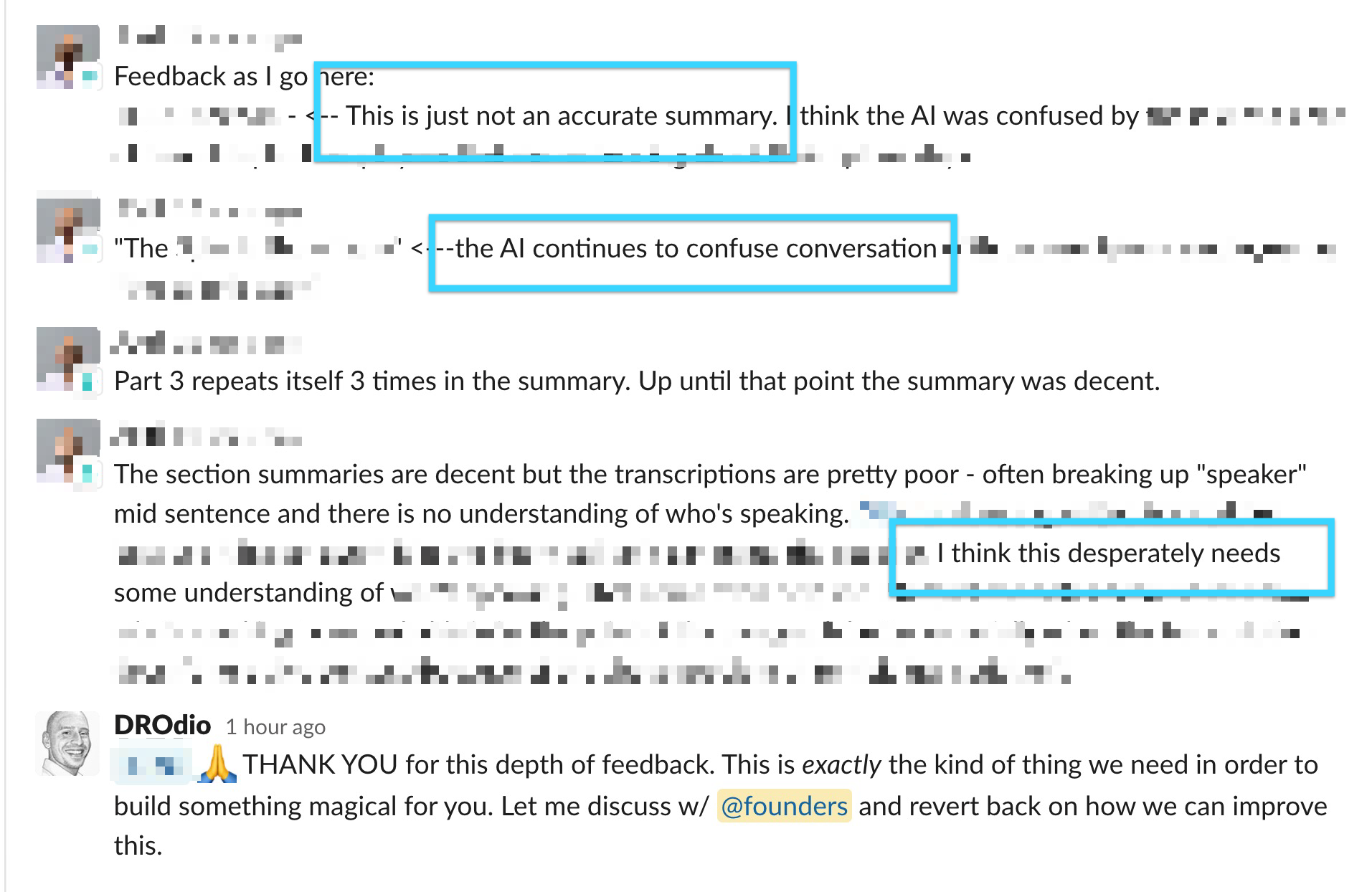
It doesn't feel great to have a user calling my baby ugly. But it feels incredible that a user cares enough to tell me. When I see this kind of feedback, I get really excited because I know a user cares enough to tell me what they wish Storytell could do.
And I treat this feedback like the flint that's caused a few wisps of smoke in the kindling. I know that I have a very limited amount of time with any early user before they just turn their attention elsewhere. I can only cajole them so much.
💡 When users start to give you unsolicited feedback based on their actual experiences, that's an incredibly strong and precious signal that they are shifting mentally from"I'm doing you a favor because you asked me to"to"I could actually see a reason that I might someday care about this."
If we don't pounce on the feedback and quickly show a user that we're listening and iterating to improve their experience, that early bit of smoke quickly gets snuffed out and we're back in the cold darkness.
But if we can pounce on it and iterate quickly to make an improvement that we put back in front of the user, then those wisps of smoke turn into a small bit of fire in the kindling. And if we repeat this process hundreds or thousands of times, across more and more users, then we earn an opportunity to create a raging bonfire — a really impactful product that can change the world.
But it all starts with the attitude that the wisps of smoke from early user feedback are precious and very time-sensitive. The small bit of initial fire is fragile and could easily go out. It takes an insane amount of dedication and attention to coax that fire into being and create a product that goes from Stage 0 to Stage 1 of Product-Market Fit.
Specific recommendations:
- Create an SLA with your co-Founders around responding to user feedback. Within an hour is ideal. Show your first users that there's nothing more important to you than listening and learning from them.
- When you respond, show gratitude for them taking the time to care. They really don't have much or any of a reason to at this point, other than their loyalty or care for you as a human. No sane person would spend their time using something as broken as what you're building at this stage.
- Respond quickly, and respond thoughtfully. If you don't have the answers initially, let them know that you'll get back to them. Ask them to keep the feedback coming. Make sure they know you're listening.
- Most importantly: Iterate quickly. Users typically won't know the solution. But they will know the problem. It's your job to translate their pain into a better solution. This means you don't need to just build what they're asking you to build. Look past any of their solutions to really understand their pain points, look for common patters across multiple users, and then ship something quickly that solves for that pain in a way that's consistent to your Vision, Mission and Strategy.
- Related topics: Blinkist: Good Strategy / Bad Strategy and Foundation of "How to Win:" Translating Your Vision & Mission into Strategy and OKRs
💡 Related:Mistakes Founders Often Make with Vision, Mission & Values
The Ideal round-trip:
- A user provides feedback.
- One founder responds in minutes — even if just to say that they've received the feedback and they'll respond within [x] time. (Setting expectations with a user on response timing really helps build trust)
- Founders discuss the feedback and identify a feature they want to prioritize based on the feedback.
- They build & ship the feature within 1 to 2 days, and then put it back in front of that early user for another round of feedback.
- Rinse and repeat until you start to see signals that the user is actually starting to care.
You'll know your small kindling 🔥 is growing into a larger bonfire 🔥 when they start to pull and you stop having to push. Meaning users are reaching out to you asking for more features, or about how to do XYZ in your product instead of you having to ask them to take a look.
Related: How Segment.io found Product Market Fit
🤖 Here's the Storytell report for the video above
About FounderCulture: Only 1 of every 200 seed-funded startups make it to a $1Bn valuation. FounderCulture exists to improve those odds for Founders worldwide by removing the friction of founding and scaling venture-backed companies. We are building a trusted community to share knowledge with authenticity and vulnerability among Founders. FounderCulture is created by Founders, for Founders. Learn more about FounderCulture:
- Welcome to FounderCulture
- Why Founders Need FounderCulture
- Our Vision, Mission, Values & OKRs
Become a Patron if you'd like to see us create more content like this for Founders:
- Support FounderCulture: Become a Patron, Buy an NFT or send BTC/ETH .
- Thank you, FounderCulture Sponsors