We are Atoms That Were Stars: Bridging Quantum Mechanics, Consciousness and Spirituality
Exploring Faggin's quantum theory: consciousness isn't brain-created but fundamental to reality. Humans are translation layers converting quantum possibilities to classical experience. Our star-atoms are just tools—we're windows through which universal consciousness experiences itself.

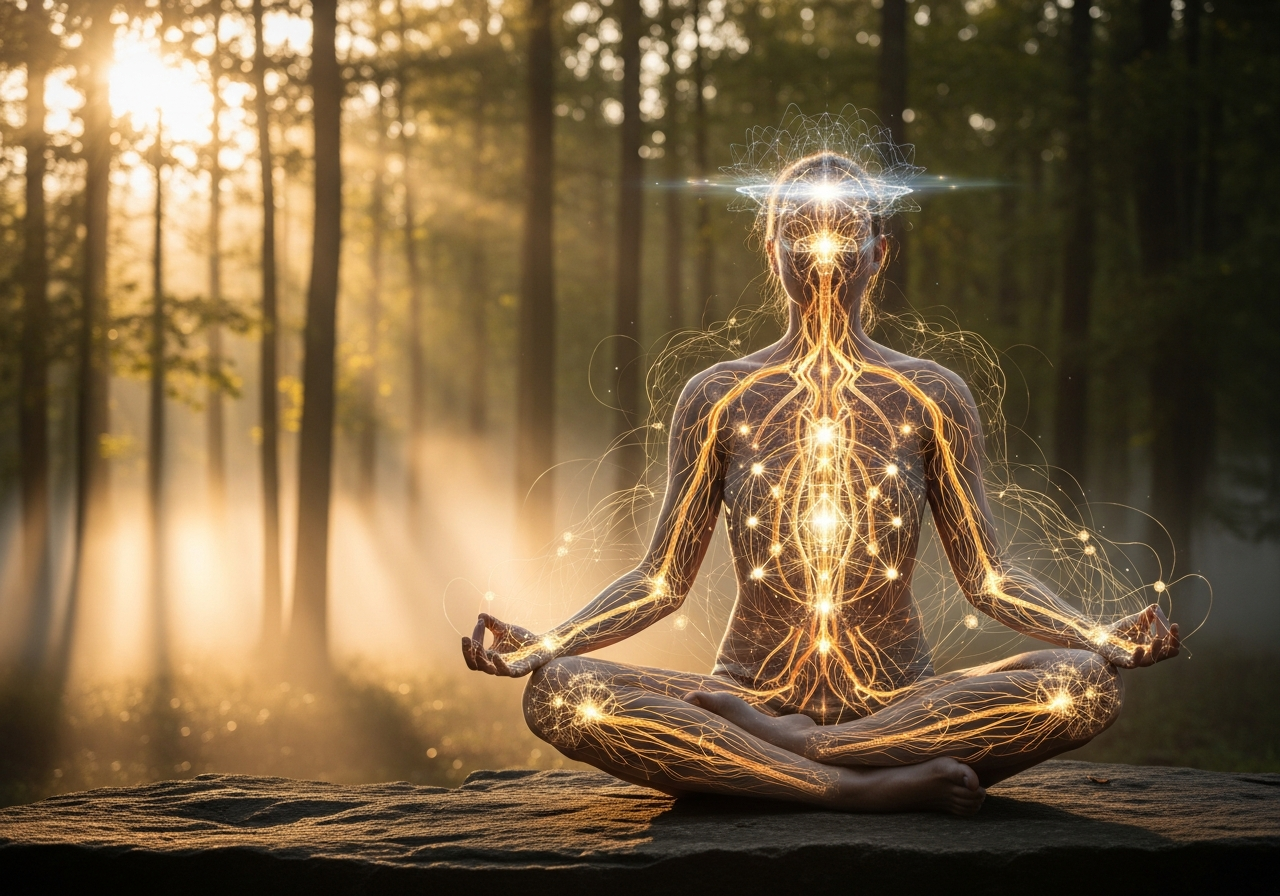
I've always held the belief that when we're born, we borrow energy from the Universe, and when we die, we return that energy to be passed forward to others. It's especially intriguing to me since the atoms we're made of were once inside stars. My beliefs about energy have felt true to me but sound a little woo-woo when said out loud at dinner parties so I haven't talked about it much.
Then I started learning about Federico Faggin's work detailed in his new book "Irreducible: Consciousness, Life, Computers, and Human Nature," and suddenly, my belief had a framework to explore. This blog post is that exploration.
Humans as the "Quantum to Classical" Translation Layer
Federico Faggin—the physicist who invented the microprocessor—says everything we believe about consciousness is backwards. Your brain doesn't create consciousness. Consciousness is woven into the quantum fabric of reality itself, and your body is the instrument that translates quantum possibilities into the solid, physical world you experience.
Instead of the brain producing consciousness through chemistry and electrical signals, he argues that it's a fundamental property of the Universe, existing at the quantum level, and your brain is simply the device that collapses quantum possibilities into the concrete reality you perceive.
His claim is that at the quantum level, consciousness is fundamental—as basic as space, time, and energy. Your body is the bridge that transforms quantum uncertainty into the definite, physical experience of being alive.
Some scientists think consciousness emerges when you get enough neurons firing together—like how a pile of sand becomes a "heap" at some point. Faggin says they're looking at the wrong scale. Consciousness doesn't emerge from complexity. It exists at the quantum foundation of reality itself. Your brain doesn't create consciousness; it's the translator that converts the quantum scale into the classical world of sight, sound, and thought.
If true, that means we're not passive observers of the Universe. We're active participants in creating what becomes real.
The Quantum Clues: Why Some Scientists Think Consciousness is Fundamental
Here's where it gets scientific. Faggin isn't alone in this radical claim. Several clues from quantum mechanics itself suggest consciousness might be irreducible—meaning it can't be broken down into simpler parts or explained away by brain chemistry alone.
The Measurement Problem
Since the 1930s, physicists have wrestled with what John von Neumann called the "measurement problem." In quantum mechanics, particles exist in superposition—meaning they're in multiple states simultaneously until measured. An electron can be spinning both clockwise and counterclockwise at the same time. The moment you measure it, the superposition collapses into one definite state.
But here's the puzzle: What counts as measurement?
Does a photon hitting a detector collapse the wave function? Or does it require a conscious observer to know the result? Von Neumann and later Eugene Wigner suggested that consciousness itself might be the collapse mechanism. The universe doesn't "choose" until someone is there to experience the choice.
Most physicists today don't love this interpretation—it feels too mystical. But the problem hasn't gone away. What does cause collapse remains one of the deepest unsolved puzzles in physics.
How Humans Could Bridge Quantum and Classical Realms
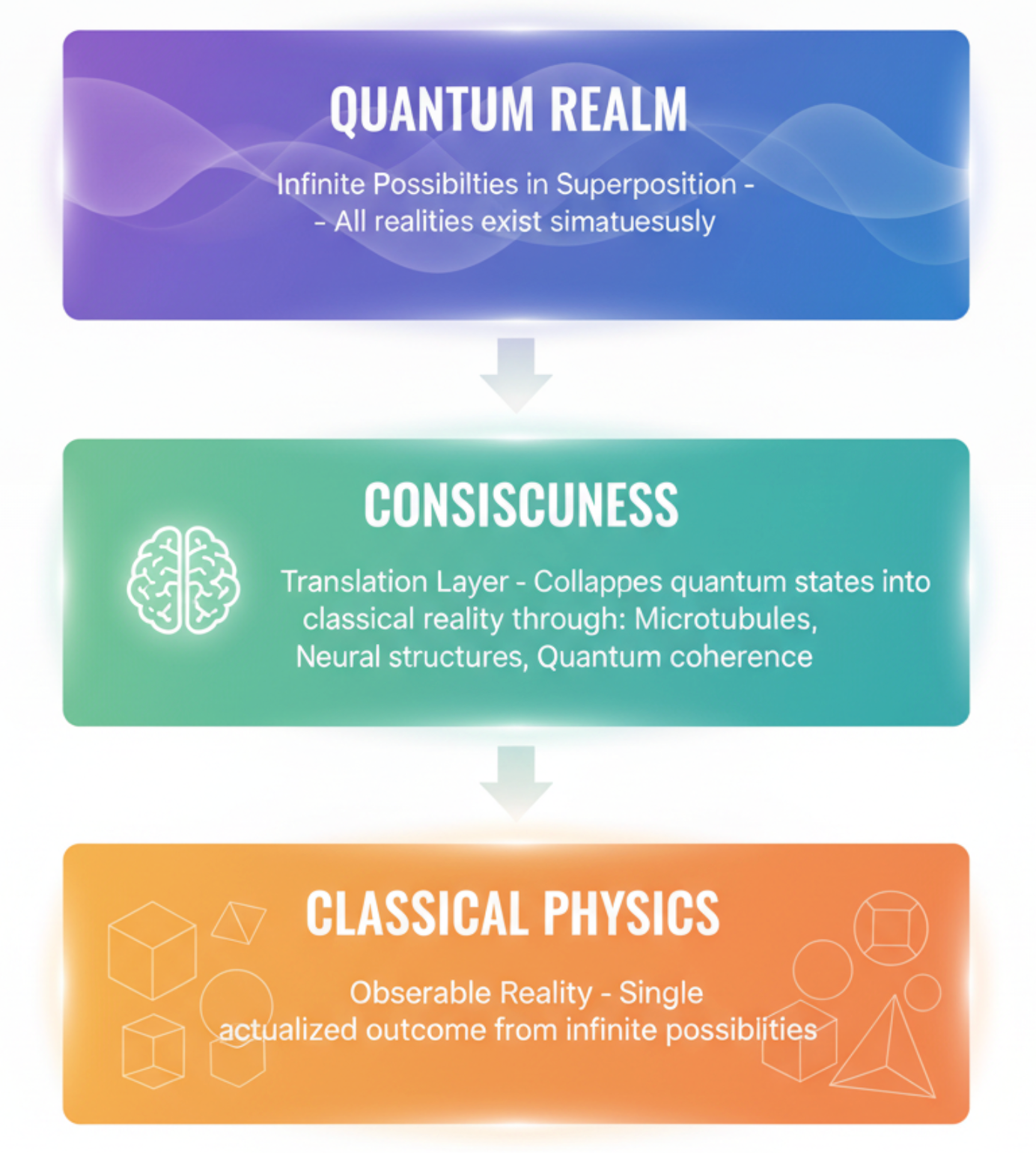
At the quantum level, possibilities exist in superposition with all being simultaneously true. What if when human consciousness interacts with these quantum states through our biological machinery (specifically, structures like microtubules in our neurons), we collapse those infinite possibilities into the singular experience we call "life"?
What if we're literally translation layers between the quantum realm and classical physics?
There's growing evidence that quantum effects – superposition, coherence, entanglement – operate in biological systems. Recent science postulates that photosynthesis uses quantum coherence at room temperature. Birds navigate using quantum entanglement in their retinas to sense magnetic fields. Your body might be a quantum machine operating at 98.6 degrees. More of this scientific literature in the reference citations at bottom.
We're Not CPUs, We're APIs: How Consciousness Might Translate Quantum to Classical
Since I usually write about technology, let me try describing this framework with a tech analogy:
Let's start with "humans as systems running code": A CPU (our brain) runs biological wetware code – our DNA. The CPU executes deterministic instructions defined by the DNA. Input goes in, processing happens through predictable logic gates, output comes out.
But according to Faggin's quantum consciousness model, that's not what we are. We're not CPUs running deterministic code on biological hardware. We're something far stranger: Humans are translation layers between incompatible systems. We're acting as an API between the quantum realm and classical physics reality.
From Observer to Participant
The standard quantum mechanics interpretation says observation collapses wave functions, but treats consciousness as a passive observer—merely revealing a pre-existing reality.
Faggin flips this: Consciousness plays an active role in determining quantum outcomes. The collapse of quantum states through observation represents consciousness choosing or actualizing one reality from many potentials—an act of creation, not passive measurement.
Your consciousness may be woven into the fabric of the Universe itself.
Understanding the Three-Layer Stack
Faggin's CIP framework gives us an architecture that as technologists, we can map directly to our mental models:
C-Space (Consciousness Space): Think of this as the quantum backend—the semantic realm of raw subjective experience. This is where superposition exists: infinite possible states held simultaneously, entangled across spacetime. If you've worked with quantum computing concepts, you know qubits can represent multiple states at once. C-space is that—but for consciousness itself.
I-Space (Information Space): This is your API layer. The symbolic structures that convey meaning. When quantum superpositions need to become something the classical world can interact with, they pass through this translation interface. This is where the "collapse" happens—where infinite possibilities get serialized into one actualized outcome.
P-Space (Physical Space): The classical world you're reading this on. The deterministic physics your computer runs on. But here's the kicker: according to Faggin, this isn't the "real" reality—it's the rendered output. Just like words on the page of a book are the rendered output of the intentions of the writer. Our physical world is "evocative symbols of a deeper reality" that exists in quantum form.
Faggin has a beautiful way of describing this in practice: When you look at a person you love deeply and you tell them "I love you," those words are only a small approximation of what you are feeling about that person. Faggin argues that your feeling lives in the quantum state and the words you say collapse that deep, rich feeling into classical information – symbols that convey only a shadow of the quantum state. By saying "I love you" you are translating a quantum mechanical "Consciousness Space" into a classical physics "Information Space" that gets conveyed between the two of you in "Physical Space."
Has Religion Been Saying This?
This framework isn't new to human experience. What if we've been feeling this truth for millennia? The idea that life is borrowed energy that returns, circulates, or is redistributed appears independently across virtually every spiritual tradition on Earth. It's an astonishing convergence.
Eastern Traditions: The Circulation of Qi and Prana
- Taoism describes life as animated by qi (chi)—the fundamental energy of the universe. When you're born, you receive qi from Heaven, Earth, and ancestors. When you die, qi disperses and returns to the Tao, the underlying cosmic order. This is almost word-for-word the borrowed energy belief.
- Hinduism teaches that Atman (individual soul/energy) is part of Brahman (universal reality). Consciousness temporarily inhabits a body at birth. At death, energy is released—either reincarnated or reunited with Brahman. The emphasis is on energy continuity, not annihilation.
- Buddhism insists there's no permanent soul, but rather a continuum of energy, consciousness, and causation. You arise from prior causes and conditions. At death, the aggregates disperse, but karmic energy continues. The flame metaphor captures this beautifully: one candle lights another—nothing permanent, nothing lost.
- Jainism speaks of Jiva—life energy that animates all living beings. This energy transitions according to karma, maintaining an extremely literal view of energy conservation across lives.
Indigenous Wisdom: Returning to the Land
- Animism, found in cultures worldwide, teaches that all beings—humans, animals, plants, rivers—share vital energy. When you die, your life force returns to land, ancestors, or the spirit world. This is exactly "passing energy back to the earth".
- Native American spiritualities view life as a circulation of spirit among people, animals, and land. Your spirit joins ancestors and the land when you die. It's often explicitly framed as borrowing life from nature.
- African Traditional Religions speak of life force (ashe, nyama) flowing through community and cosmos. At death, your energy strengthens ancestors and the living. There's a powerful emphasis on continuity and responsibility across generations.
- Australian Aboriginal Dreaming teaches that life energy comes from the Dreamtime and returns there. When you die, your spirit rejoins the land and ancestral songlines. Energy is literally embedded in geography.
Mystical Branches: The Return to Divine Source
- Kabbalah (Jewish mysticism) describes divine light (Ein Sof) flowing into creation. At birth, a spark inhabits your body. At death, the spark returns upward or is recycled through gilgul (reincarnation). Energy borrowed from God, returned through life and death.
- Sufism (Islamic mysticism) teaches that all beings emanate from divine energy. Death is return to unity with God (fana)—a strong dissolution-back-into-source framing.
- Christian Mysticism Thinkers like Meister Eckhart describe God as living energy animating creation. The soul returns to divine source at death. Less explicit about "energy," but conceptually very close.
Ancient Philosophy: Cosmic Breath and The One
- Stoicism (Ancient Greece/Rome) taught that Pneuma (cosmic breath or fire)animates all life. At death, Pneuma returns to the cosmos. This is an explicit "borrowed breath" metaphor.
- Neoplatonism described all existence emanating from "The One." Death is the return of the soul to its source—a strong cosmic recycling logic.
- Shinto (Japan) believes life force (kami) inhabits people and nature. At death, energy becomes ancestral kami or returns to nature—a very earth-aligned version of this belief.
The Universal Archetype
What's remarkable is that this belief appears independently across traditions that had no contact with each other. From Taoist China to Aboriginal Australia, from Kabbalah to Stoicism, humans have felt the same truth: Life is a temporary localization of cosmic energy, and death is its redistribution.
Perhaps these traditions weren't just guessing. Perhaps they were describing something they could feel—the actual physics of consciousness operating at the quantum level, translated into the metaphors and symbols available to them.
Christianity talks about the Holy Spirit—a consciousness that pervades all things, connecting us to the divine. "In Him we live and move and have our being." That's not just a metaphor—that might be a description of quantum entanglement linking all consciousness to a fundamental reality.
Baha'i Faith teaches that the Universe is one interconnected system where the material and spiritual worlds are two aspects of the same reality. Their concept of the soul as a sign of God existing within us maps beautifully to Faggin's idea that consciousness is fundamental and our physical bodies are its symbolic expression.
Meditation traditions across cultures have long taught that by quieting the mind, we can access deeper levels of reality and higher levels of enlightenment. Now we have a potential mechanism: Perhaps meditation allows us to tune into quantum coherence in our neural structures, accessing information at a level that transcends classical spacetime boundaries.
Exploring the Physics of Prayer and Meditation
If we're translation layers, then practices like meditation and prayer may not just be for psychological comfort. They might be technologies for attuning to our quantum nature.
Consider this: If quantum entanglement can link particles across space instantaneously, and if our consciousness operates at the quantum level through structures like microtubules or Posner molecules in our neurons, then practices that enhance quantum coherence in these structures might genuinely connect us to non-local aspects of reality.
Meditation might not just calm your mind. It might increase quantum coherence time in your neural tissue.
When monks show different brain patterns during deep meditation, when people report mystical experiences of unity with all things, when prayer creates measurable changes in physiology – maybe these aren't just neurochemical tricks. Maybe they're us learning to be better translation layers, more intentionally collapsing quantum possibilities into classical outcomes.
How to Attune: Practical Steps for Being a Better Translation Layer
So what does this mean for how we live? How can I work to attune to human nature as quantum-classical translators?
- Start from presence, not thought: If consciousness is fundamental and creates reality through observation, then the quality of our attention matters immensely. Practices that train presence – meditation, breathwork, even something as simple as truly noticing the taste of your food – might be training quantum coherence.
- Embrace uncertainty as possibility: At the quantum level, uncertainty isn't a bug; it's a feature. Superposition means multiple realities exist simultaneously until observation collapses them. When you face uncertainty in life, you're literally facing quantum possibility. Your consciousness will collapse it into something. Be intentional about those choices.
- Cultivate interconnection: If quantum entanglement connects all consciousness at a fundamental level, then practices that remind us of our interconnection – compassion, service, community – aren't just nice ethics. They're aligning with the actual physics of reality.
- Pay attention to the gaps: The space between thoughts, the pause between breaths, the silence between sounds – these might be moments where our translation layer is most permeable, where we can sense the quantum substrate before it collapses into classical experience.
- Explore the "stereo volume knob": I've written before about how food has a "stereo volume" that calls to me. But what if that's true for everything? What if the volume knob on our attention to different aspects of reality is actually our translation layer at work? What we pay attention to literally becomes more real through our observation.
The Atoms Inside Us That Were Stars
Let's circle back to where we started: The atoms in our bodies were once atoms of stars.
If Faggin is right, the consciousness experiencing reality through these star-atoms isn't generated by those atoms. Consciousness is fundamental, and these Universe-traversing atoms that form our human bodies are the tools it uses to translate infinite quantum possibility into finite classical experience.
When we're born, we don't just borrow atoms. We become a translation layer that lets universal consciousness experience itself from a new vantage point. But the consciousness itself? That was never ours to begin with. We were always just the interface.
That ancient intuition that we borrow energy and return it might be more than metaphor. It might be the poetic description of the actual physics by which consciousness orchestrates quantum collapse into the lived experience of being alive. We're not separate from the Universe looking at it. We're each windows into the Universe looking at itself, through translation layers that turn possibility into reality, quantum into classical, everything into something.
The atoms that compose each of us were forged in the hearts of dying stars, but the consciousness observing through those atoms was never born and never dies. It may be woven into the quantum fabric that connects all things across spacetime. When we take our first breath, we don't borrow energy from the Universe; we are the Universe momentarily concentrated into one translation layer, one vantage point, one way of turning everything into something.
In our children, the Universe continues the story our ancestors began, entangled with all that is, creating an unbroken chain of apertures across generations—each one a continuation, each one entirely new, in the eternal act of the Universe experiencing itself through lineages of wonder.
And when we die, the energy we channeled in our lives may still be part of the fundamental fabric of reality. The translation layer our bodies represented dissolved, but what we translated—the love, the ideas, the connections, the energy we amplified—that continues. It may be woven into the people whose lives we touched, into the work we did, into the quantum field itself.
I'll let you know how things go at the next dinner party!
Want to dig into the theories and research?
Federico Faggin's "Irreducible: Consciousness, Life, Computers, and Human Nature"
Physicist and physician Dr. Anita Goel has designed the equivalent of the double slit experiment in a living system, to test if the nanomachines that read and write DNA could operate quantum mechanically. In this interview with Hans Busstra, Goel talks about her experiment and explores the new theoretical framework it could lead to: A new physics to understand life, living systems and consciousness. Youtube video
Quantum Coherence in Photosynthesis at Ambient Temperatures: The role of quantum coherence in photosynthetic energy transfer represents one of the most significant discoveries in quantum biology over the past two decades. Multiple research groups have documented quantum mechanical phenomena operating in biological systems at physiologically relevant temperatures—a finding that challenges the long-held assumption that quantum effects rapidly decohere in warm, wet biological environments. PDF with relevant scientific literature.
Quantum Vibrations in Microtubules at Physiological Temperatures: Research on quantum vibrations in microtubules (MTs) at physiological temperatures, with particular focus on resonances in the megahertz (MHz) range and potential coupling to EEG brain rhythms. PDF with relevant scientific literature.
Geeking out on Orchestrated Objective Reduction (Orch OR) Theory: Imagine reality at its smallest scale is like a coin spinning in the air—it's simultaneously heads and tails until it lands. For decades, scientists debated what makes the coin "land" and become just one thing: Does an observer watching it cause this, or do all possibilities somehow continue existing in parallel universes? Roger Penrose proposed a radically different answer: The Universe itself decides, based on something you wouldn't expect—gravity. His theory says that when quantum particles exist in multiple states at once (like that spinning coin), each possibility creates its own tiny wrinkle in the fabric of spacetime, the four-dimensional structure Einstein showed us underlies all reality. When the difference between these wrinkles—measured by their gravitational "weight"—gets large enough, the situation becomes unstable, like a house of cards that can't support itself anymore, and reality spontaneously "chooses" one outcome. This isn't random luck or dependent on someone watching; it's built into the architecture of spacetime itself. What makes this truly profound is a connection to consciousness: When combined with Stuart Hameroff's discovery that brain cells contain microscopic structures vibrating at quantum frequencies, Penrose suggests that the moment when quantum possibilities collapse into one reality might be the moment you experience a conscious thought. In other words, your awareness—your experience of having a mind—may not just happen in the Universe but may be woven into the same fundamental process that shapes the geometry of space and time itself, connecting your inner mental world to the deepest physical laws governing existence. . PDF with relevant scientific literature.
I used Storytell.ai as a thought partner to help me write this post. Read my behind-the-scenes "how I did it" post here.